Shower screen replacement when the tiling has to stay
Most people replacing a screen are not refitting the bathroom. The question is whether a new screen can land on, or close to, the fixings the old one used without taking tiles off the wall.
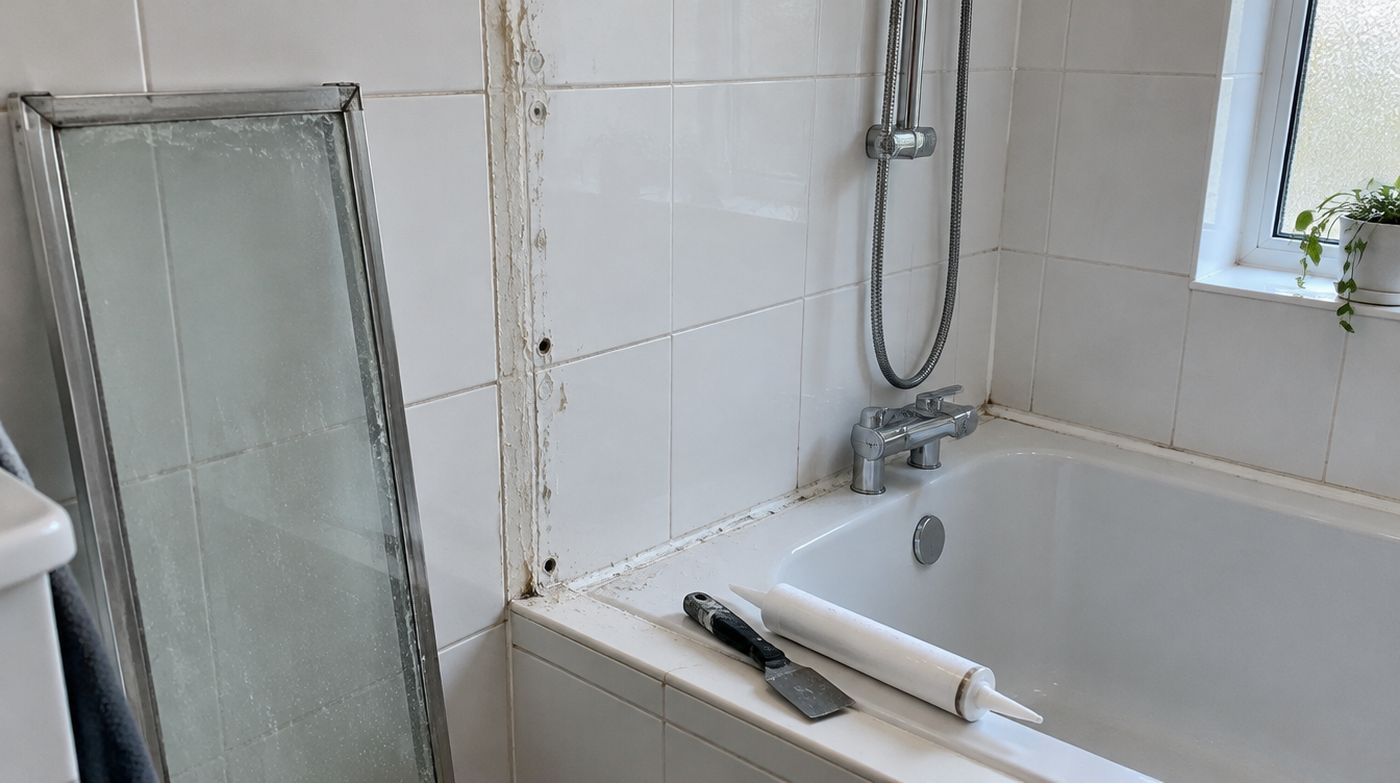
What does shower screen replacement involve if the tiles stay?
A shower screen replacement in a finished bathroom is a different job from fitting a screen during a refit. The sizes are dictated by what is already there: the tray or floor, the tiled walls with their existing holes, the upstand, and sometimes a boxed-in stack. The glass is easy. The work is in deciding where the new fixings can go, getting the old sealant off without damage, and finding out what the previous screen was hiding. We have touched on replacing a screen without retiling elsewhere on the site, and this page goes through it properly.
The honest starting position is that most replacements can be done without retiling, a minority cannot, and you can usually tell which from a survey rather than after the old screen is out. Anyone who says for certain before looking is guessing in whichever direction suits them.
Measuring to existing fixings: when can the holes be reused?
Old fixing holes are an asset. A new full height wall channel is typically 20 to 26mm wide with a continuous back face, so it will frequently cover a line of old holes completely, which is why a channel is often the simplest answer on a replacement even when clamps would look neater. A wider or longer backplate on a clamp or hinge can do the same job over a single hole.
Where the old holes cannot be covered, the options are to fill and re-drill at least a plug’s width away in sound tile, to move the fixing into a grout line, or to accept a cover plate. Filling a hole in tile properly means a two-part filler, not grout, and it will be visible if you look for it. If the old fixings were into plastic plugs in plasterboard, reusing the position is pointless because the position was never sound in the first place.
Hole centres in hardware are not standardised
This is where replacements get expensive if handled badly. Every manufacturer sets its own hole centres in wall plates, hinge plates and bracket backs, and there is no industry standard to match. The chance of a new hinge plate lining up with an old one is poor. More importantly, toughened glass cannot be drilled, notched or cut after toughening, so any holes in a new panel must be made before the glass is toughened and must be right first time.
The practical consequence: it is almost always cheaper to replace the hardware along with the glass than to hunt for hardware that matches old hole positions. If a quote proposes reusing your existing hinges or clamps, ask whether they are the correct hardware for the new panel’s thickness and weight, and whether the gaskets are available. A ten year old clamp with a perished gasket, reused to save £40, is a crack waiting to happen.
Getting old silicone off without wrecking the tile
Old sealant comes off in two stages: bulk removal with a plastic or hardwood blade, then a solvent silicone remover left to soften the residue before a second pass. Steel blades and scrapers take glaze off tile and score acrylic trays, and the damage is permanent. On ceramic and porcelain this is a slow but reliable process. Our existing page on sealing covers why the new bead matters as much as the old one coming off cleanly.
Natural stone is the exception and deserves a warning. Limestone, marble and some slates are porous, and silicone oils migrate into the stone over years, leaving a shadow along the line of the old bead. On stone tiling, which turns up regularly in Kensington, Chelsea and Fulham bathrooms, expect a visible ghost line that no amount of cleaning removes. It is not damage caused by the removal. It is the record of where the old screen was, and a new screen in a slightly different position will leave it exposed.
What we find when the old screen comes off
Drummy tiles are the most common discovery. Tap around the fixings and a hollow note means the adhesive bed is missing or has let go, and a fixing into a drummy tile has nothing to pull against. Second most common is a cracked tile that was cracked during the original installation and then hidden under a profile or a cover plate. Third is black mould in the joint behind the old bead, which tells you water has been getting behind the sealant, usually for years.
The one that catches people out is tile coverage. A framed enclosure has wide profiles that cover the glass edge and the tile edge behind it, and plenty of installers took advantage of that by stopping the tiling short or leaving a rough cut under the frame. Swap that framed enclosure for a frameless panel with slim clamps and you expose whatever was being hidden. If you are moving from framed to frameless, this is the thing to budget for, because it is the most frequent reason a replacement turns into a tiling job.
When is retiling unavoidable?
When the tray is being changed, because the junction and the upstand change with it. When a wall is further out of plumb than the new screen can absorb, which on a frameless panel in a channel is a few millimetres and not a few centimetres. When the substrate behind the tile is unsound over the area where the fixings have to go. When several tiles are cracked and the pattern is discontinued, so a repair will be obvious anyway. And when the old frame was covering missing or badly cut tile.
Short of those, pushing a customer into a retile as part of a shower screen replacement is often laziness dressed as diligence. Working to existing holes takes thought at the survey and a bit more care on the day. It is a legitimate thing to ask a fitter to do, and a legitimate thing to get a second opinion on if you are told the whole wall has to come off.
Before you replace a whole enclosure, price the part. A perished magnetic strip, a stiff roller, a dropped hinge or a worn pivot bush are stock items costing a few pounds, and the profile usually identifies the maker.
Replacing one panel of an enclosure
If one panel of a two panel enclosure has broken, a single replacement is often possible. The panel has to be remade to the original size with the original hole positions and edge detail, so the existing panel and hardware become the pattern. Measuring an installed panel’s holes to the accuracy toughening requires is fiddly but perfectly doable. The limits are hardware that is obsolete, hole positions that cannot be verified because the broken panel has gone in a skip, and glass with a pattern or tint that is no longer made.
Keep the broken pieces, or at least photograph the hardware, the profile and any stamp in the corner of the glass before anything is thrown away. That one step decides whether you are buying a panel or a whole enclosure.
Why shower screens break on their own
Most breakages are impact, and almost always impact on an edge or a corner rather than the face. Toughened glass has its strength in a compressed surface layer, so a face knock it shrugs off while a sharp blow to an exposed edge, from a dropped bottle of shampoo or a shower handset swinging on its hose, can set it off. Chips sustained during the original fitting can take years to turn into a break.
There is also genuine spontaneous fracture. Tiny nickel sulphide inclusions in the glass can expand slowly over years and burst a toughened panel with no impact at all, which is why heat soaked toughened glass to BS EN 14179 exists for critical applications. It is rare in a domestic shower screen, it is nobody’s fault, and you are more likely to be the victim of a knocked edge. If you are claiming on accidental damage cover, be realistic: the excess on a typical home policy often exceeds the cost of one replacement panel, and a claim stays on your record.
FAQ
Questions about shower screen replacement
Can you replace a shower screen without removing the tiles?
In most cases yes. A new full height wall channel is wide enough to cover a line of old fixing holes, and a clamp or hinge with a larger backplate can cover a single one. Where a hole cannot be covered it can be filled with a two-part tile filler and the fixing moved a plug’s width away into sound tile or into a grout line. Retiling becomes unavoidable when the tray is being changed, the wall is badly out of plumb, the substrate behind the tile is unsound, or the old framed enclosure was covering missing or roughly cut tile.
Can you replace just one panel of a shower enclosure?
Often, yes. The replacement has to be made to the original panel size with the same hole positions, edge finish and thickness, because toughened glass cannot be drilled or cut once it has been toughened. That means the surviving panel and the existing hardware act as the pattern. It fails when the hardware is obsolete, when the broken panel has been thrown away so the hole centres cannot be verified, or when the glass was patterned or tinted in a finish no longer produced. Photograph the hardware, the profile and the stamp in the corner of the glass before anything is cleared away.
Why did my shower screen shatter when nobody touched it?
Toughened glass is held in tension internally, so when it fails it fails completely and suddenly, which makes the cause look mysterious. Usually it is delayed impact damage: a chipped or nicked edge from installation or from something dropped weeks earlier, which finally propagates. Less commonly it is a nickel sulphide inclusion, a microscopic impurity that expands over years and bursts the panel without any contact at all. That is the risk heat soaking to BS EN 14179 is designed to reduce. Either way it is a known characteristic of toughened glass rather than a sign that you did something wrong.
Get a price for your shower screen
Tell us roughly the size of the opening, or book a free survey. Most screens are measured, made and fitted within a week.