Fixed glass shower panels: how they are held and why they fail
A fixed panel has no moving parts, which is why people assume there is nothing to specify. Everything that goes wrong with one comes down to how it is restrained at the wall, what it stands on, and what happened to its edges.
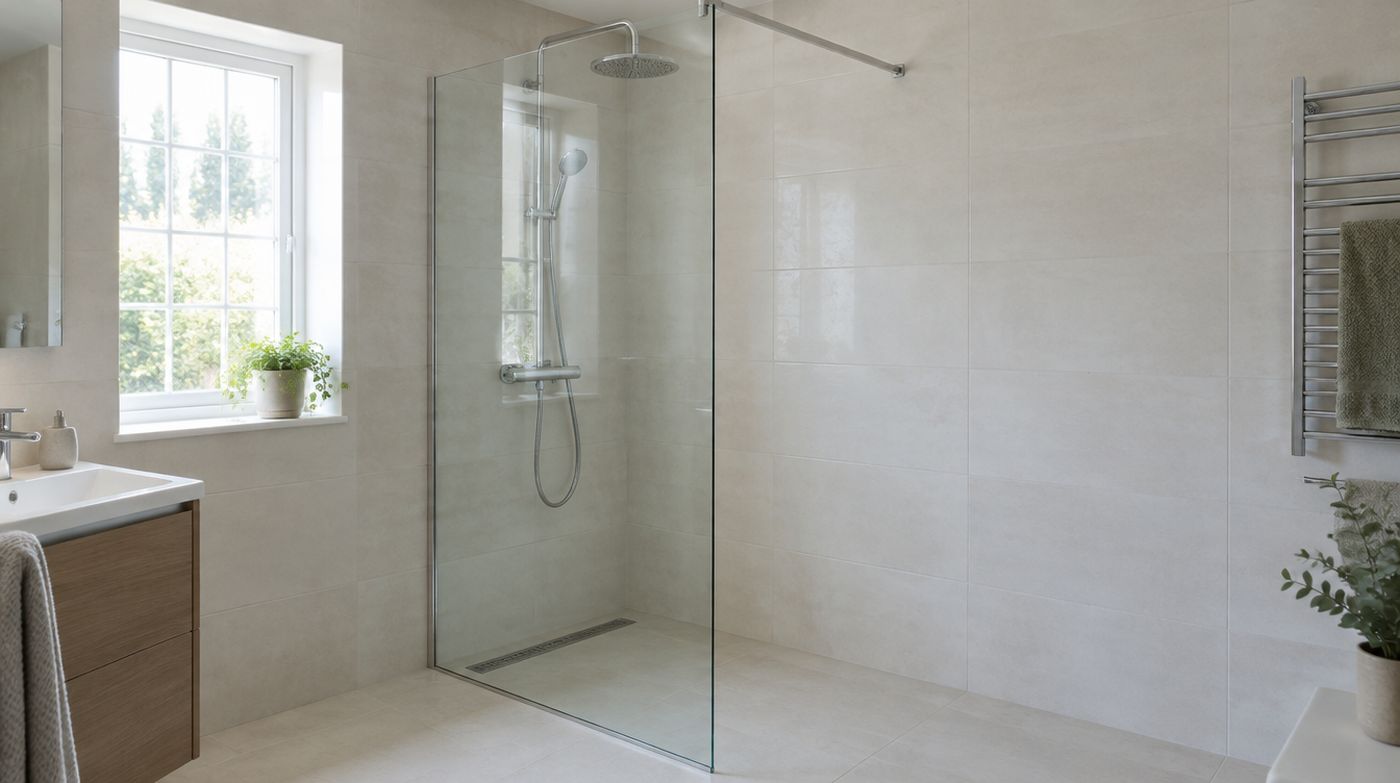
What do fixed glass shower panels actually have to do?
Fixed glass shower panels look like the simplest product in a bathroom and structurally they are the most interesting. The panel has to carry its own weight into the wall, resist somebody leaning or falling against it, resist a towel being pulled off the top edge, stay plumb while the building around it moves, and do all of that while standing in water. Glass weighs roughly 2.5kg per square metre for each millimetre of thickness, so a 900 by 2000mm panel is about 36kg in 8mm and about 45kg in 10mm. That load has to go somewhere specific.
It goes into the wall fixings, and that is why the question of what is behind your tiles matters more than almost anything else on the quote.
Deflection: why a tall panel feels springy
Push the free vertical edge of a fixed panel and it moves. How much it moves is governed by two things. Stiffness rises with the cube of thickness, so 10mm glass is roughly twice as stiff as 8mm, not 25 per cent stiffer. And deflection rises steeply with the unsupported height and width, which means a panel that is 2000mm tall and restrained at one edge will feel markedly softer than the same glass at 1850mm.
So the useful lever is rarely thickness. It is how much of the panel is restrained. A full height channel supports the whole vertical edge and transforms the behaviour of an 8mm panel. Two small clamps restrain it at two points and leave the rest of that edge to work. Choosing the restraint first and the thickness second is the right order, and it is the opposite of how most quotes are built. The 8mm against 10mm question is covered on our frameless page, so we will not rehearse it here.
There is a practical ceiling on panel size as well. Standard toughened stock and standard hardware comfortably cover the panel sizes a normal London bathroom needs, roughly up to a metre wide and two metres tall. Push past that and you are into heavier glass, heavier fittings, two people to carry it up a narrow staircase and a panel that will not turn on a half landing. Before agreeing an unusually large single panel, walk the route from the street to the bathroom door and look at it as a delivery problem.
Wall channel or clamps? Two ways of holding the same glass
A channel is a U-section screwed to the tiling, into which the glass is set on packers and sealed. It supports the full edge, it hides a few millimetres of out-of-plumb and a modest bow in the wall, it spreads the load across several fixings, and it covers old holes on a replacement. What it does not do is disappear, which is the only reason people reject it.
Clamps hold the glass at two or three points with the minimum of visible metal. They look better, they concentrate load into small areas, they demand accurate fixings into solid backing, and crucially they hide nothing. With clamps, the glass has to be cut to the wall’s actual shape, including any lean or bow, because there is no profile to absorb the difference. On a straight, solidly built wall in a new-build flat, clamps are an easy choice. In a Victorian house in Islington or Ealing where the wall has been patched, re-plastered and tiled over an old chase, a channel is usually the better and cheaper answer, and a fitter insisting on clamps for the look is making the job harder for you and riskier for the glass.
The floor junction is where fixed panels leak and crack
Glass must never bear directly on tile, stone or metal. It stands on setting blocks or packers which spread the load along the bottom edge, and it is sealed afterwards. A panel resting its full weight on one hard point, typically a proud tile edge or a lump of adhesive, has a stress concentration at exactly the corner that eventually breaks. If a fitter drops a panel into position and it does not sit level on its packers, the answer is to fix the packers, not to let the silicone take up the difference.
On a tray, the panel sits inboard of the upstand so that water running down the glass lands where it can drain. The sealing detail follows from that, and we have written about silicone separately, so the point here is the bearing rather than the bead. Get the glass standing correctly and the sealing is straightforward. Get it standing badly and no amount of sealant rescues it.
The top edge is worth a thought too. A fixed panel that stops at 1900mm with nothing above it has a free top edge that people hang towels on and children hold. That load is applied at the furthest point from the fixings, which is why towel rails and hooks belong on a wall and not on the glass. If someone is routinely going to lean on the top of the panel, say so at the survey and the restraint changes.
Edges, holes and cutouts: where toughened glass is vulnerable
Toughened glass is strong in the face and comparatively vulnerable at the edge. The toughening process puts the surfaces into compression, and the edge is where that compression can be released by damage. A chip you can catch a fingernail in is a weak point for the life of the panel. Polished edges are less vulnerable than arrised ones and worth specifying on any exposed vertical edge you will walk past daily.
Everything that removes material has to happen before toughening: cutting to size, polishing, drilling for hinges or knobs, and any notch for a tap or an upstand. After toughening the panel cannot be altered by anybody, anywhere, which is why sizes have to be right and why nobody should be grinding or drilling your glass on site. Holes and cutouts also have to be kept clear of edges and corners by a sensible margin, which the processor will set from the thickness and the hole size. If a design needs a hole right at a corner, the design changes.
Why do fixed glass shower panels fail?
Overtightened clamps are the leading cause we see. A clamp is tightened onto a gasket to a specified torque, and when it is driven down hard the gasket is squeezed out and metal loads the glass directly. The panel usually survives the day and cracks weeks or months later, starting at the clamp. Second is forcing a panel plumb when the wall is not, so the glass is held in permanent twist. Third is grit trapped under the bottom edge during fitting, which does the same thing as a hard point. Fourth is edge damage in transit or storage that nobody inspected before the panel went up.
Note what is not on that list. Thin glass is rarely the cause. A correctly restrained 8mm panel outlasts a badly fixed 10mm one every time, and upgrading thickness to compensate for poor fixing is paying for weight rather than for strength.
What to put on the order, and what to refuse to pay for
The order should state the panel size taken at three heights, the thickness, the edge finish, the restraint method and its finish, the position and size of any cutouts, the use of setting blocks, and whether a stabilising bar is included. If a bar is included, ask what it is fixed into, because a bar into plasterboard with nothing behind it is decorative. Whether you need one at all is set out on our frameless page.
Two things to push back on. 10mm glass on a short panel already held in a full height channel, where the extra cost buys weight, a heavier carry up a London staircase and no useful stiffness. And low iron glass on a panel nobody will look through at an angle, such as a screen against a tiled return. Save the low iron money for a large clear panel where the green edge would actually show. The place to spend more is the fixing: a proper pattress or noggin behind the board, or a longer channel into something solid, is worth more than any upgrade to the glass itself.
FAQ
Questions about fixed glass shower panels
How is a fixed glass shower panel fixed to the wall?
Either in a full height U-channel screwed to the tiled wall, with the glass set on packers inside it and sealed, or with two or three clamps bolted through to solid backing. A channel supports the whole vertical edge, spreads the load over several fixings and absorbs a few millimetres of out-of-plumb. Clamps show less metal but concentrate the load and hide nothing, so the wall has to be true and the fixings have to land in brick, block or a timber stud. Plasterboard alone will not hold a full height panel, so a noggin or plywood pattress needs to go in before tiling.
Can toughened glass shower panels be cut down to size?
No. Toughening puts the glass surfaces into permanent compression, and any attempt to cut, drill, notch or grind the panel afterwards releases that and shatters it. Every operation, including cutting to size, edge polishing, drilling for hinges and any cutout, happens before the glass goes into the furnace. That is why the sizes taken on site have to be correct and why nothing can be adjusted on fitting day beyond packing and sealing. If a panel is 10mm too wide, it is a new panel, which is also why a careful survey is worth more than it costs.
Why do fixed shower panels crack at the clamp or the bottom corner?
Because that is where the load is concentrated. Clamps tightened past the point where the gasket can cushion the glass put metal directly against it, and the crack appears weeks or months later rather than on the day. At the bottom, a panel bearing on a proud tile edge, a lump of adhesive or a piece of grit has its weight going through one small point instead of across setting blocks. Forcing a panel to sit plumb in an out-of-plumb opening leaves it under permanent twist and has the same result. All of these are fitting faults, not glass faults.
Get a price for your shower screen
Tell us roughly the size of the opening, or book a free survey. Most screens are measured, made and fitted within a week.